Monday, August 21, 2006

Delaware & Hudson

The images for this section appear in Photologues. Use the link at left.

The Cooperstown & Charlotte Valley operates on a former branch line of the Delaware & Hudson between the D&H main line at Cooperstown Junction, New York, to the home town of the Baseball Hall of Fame. Operated by the Leatherstocking Railway Historical Society, the C&CV has put on a railfan weekend for each of the past several years, with a photo freight and night photo session highlighting the event. This year's railfan weekend was held on August 5-6, enticing me to D&H-land.

August 5, 2006
Heading north along the Delaware River in southern New York State, evidence of the major floods that struck the region were quite evident. Roadside ditches had turned into raging rivers during the storm, and asphalt had been eroded almost everywhere. The floods had taken out Interstate 88 near Unadilla, New York, but it appeared that New York Route 17 was almost lost as well, as a pier appeared to be nearly undermined at Deposit. Swinging away from the Delaware and heading northeast along Canadian Pacific's former Delaware & Hudson line, the destruction left by the storm was even worse -- in Bainbridge, many houses had mobile homes parked in front while homeowners repaired their dwellings. Between Sidney and Unadilla, traffic diverted off I-88 at the washout slowed passage along usually-quiet Route 7.

Approaching Otego, nearly where I'd leave the D&H and head north to the Cooperstown & Charlotte Valley, the scanner picked up a transmission from a westbound (southbound) CPR/D&H train. Almost every town has access between parallel Route 7 and I-88, and almost all those access points cross the D&H on a bridge. I used one of those access points to shoot the D&H train, led by an SD40-2 in the paint scheme of of the short-lived CPR subsidiary St. Lawrence & Hudson. I headed back west with the train and snapped off another shot at Wells Bridge before resuming my trek to the C&CV. Somehow, a second southbound snuck past me between Otego and Oneonta, where the tracks are within sight of the highway for most of that stretch.

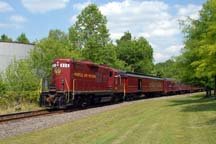
Heading north from Cooperstown Junction, I soon encountered the south end of the C&CV's passenger trackage at Milford (the southernmost eight miles is only used for equipment moves). The regular passenger train was being assembled using C&CV's Alco S4 No.3051wearing a black paint scheme inspired by the D&H. The photo freight would get S4 No.3052 in a battered blue paint scheme -- despite the rough paint, the Alco still sounded good. The photo freight followed the passenger train northward to Cooperstown, then once the passenger train headed back south the freight made frequent photo stops. Among the highlights were a stop at a through-truss bridge over the Susquehanna River, the Dreams Park station (Dreams Park is home to several baseball diamonds where 120 youth teams per week come to play and train) and the obligatory stop passing the light house behind Pop's snack stand.

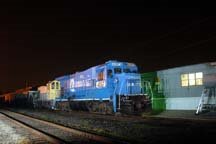
That evening the Cooperstown Blues Express made its run between Milford and Cooperstown, with a live band playing in the gondola and pizza and beer available in the dining car. It was a pleasant evening under the stars. Upon return to Milford, black No.3051 was commandeered for the photo freight, which then headed back north (at 11:00 p.m.!) for more photography at the pond behind Pop's (yours truly and Jeff Smith provided the flash lighting). The night photo session concluded with the train's well-past-midnight arrival back in Milford. I then headed off to a D&H caboose to get some sleep.

August 6, 2006
A very short night in the caboose ended when the bed & breakfast next to the railroad came alive way too early. I rose and bid farewell to the folks at the C&CV (especially Society President Bruce Hodges) and headed back to the D&H. Crossing the main line at Cooperstown Junction I noted that the signal was lit for a northbound move (the signal is always lit, and I presumed the green aspect meant the next move the dispatcher knew about would be a northbound). Good. One of my objectives for the day was to get a morning northbound passing the old D&H Coal Company silos at Cobleskill. I decided to work back against the northbound and pick him up somewhere south of Oneonta.

Getting to the sout side of Oneonta, I checked the signal at the south end of the siding at the old D&H yard. It was lit green (I thought this signal was constantly lit as well -- that would prove to be a mistake). Based on the green signal, I was now pretty sure that the next move would be a northbound. Heading back to Otego, the southbound signal was red -- that makes sense. But the northbound signal was dark -- hmmm. Still assuming that the signal at the south end of Oneonta was always lit, I decided the train hadn't made Otego yet, so I headed further south, finally stopping at Unadilla (going farther south might complicate a northbound chase due to the I-88 detour traffic). I made my stand at Unadilla and waited.

And waited.

After almost two hours of waiting, the northbound had yet to arrive. With the sun now swinging around to favor a southbound chase, I headed back north hoping for an afternoon southbound. Crossing the tracks at the south end of Oneonta, I noticed the signal was -- out. That meant when I had seen the signal lit green earlier, the northbound train was mere minutes away from where I was, and I had somehow missed the train between Otego and Oneonta as I drove south -- the same stretch where I had missed the second southbound train the day before.

New stragtegy -- I drove to Cobleskill, arriving there at about 1:00 p.m. The plan was to wait until 3:30 for a southbound. If no southbound appeared before then, I'd return home via Kingston. But if a southbound appeared, I would be set for a very nice chase in good afternoon light. I found a good photo location and promptly fell asleep, hoping the scanner would wake me up before a train arrived.

I woke up to the sound of a southbound train passing my location at 3:05. I opened my eyes in time to see a Canadian Pacific AC4400 leading a pair of Soo Line SD60s (one red, one white). I missed the first photo opportunity, but the chase was on!

It wasn't long before I heard the engineer reporting to the dispatcher that one engine was dead and another was missing one set of traction motors. This sufficiently slowed the train down on Richmondville Hill that I was able to catch the train a couple of times. A switch thrown against the train at the south end of Richmondville Siding further slowed the train's progress. But once on the downhill side of Richmondville Hill, the train provided a spirited chase. A number of the classic spots were hit, including the D&H signal gantry at Afton. Harpursville Trestle was lit on the north side (a side I hadn't shot before) and the chase ended with sweet light at Belden Tunnel, just ten miles shy of Binghamton. Niced chase!

As I headed back towards Route 17 via Harpursville I spotted another southbound in the valley. A brief thought was made of chasing this train, but I decided that by the time it got to Belden Tunnel the light would be shot. It was time to end the trip on a happy note. The only highlight of an uneventful ride back home along the Delaware River was hearing a train on the scanner working the ex-Erie line somewhere near Coshecton in the dark (I can never find a train on that line in daylight!).

Tuesday, August 08, 2006

Buckeye Rails 2006

All the images from this trip can be viewed in Photologues. Use the link at left.

The National Railway Historical Society held its 2006 Convention in New Philadelphia, Ohio, from July 18-22. I was joined by my brother Bruce and we headed for Ohio to check out the event, plus do some railfanning along two interesting Ohio shortlines, the Ohio Central (which would host three of the Convention trips) and the Wheeling & Lake Erie.

July 15, 2006
We left New Jersey in the morning, making a stop along Amtrak's ex-Pennsylvania Railroad main line at Christiana to get a Keystone service passenger train passing the freight house that has been restored by the Lancaster Chapter NRHS. Just before the train's arrival, a heavy rain swept through, and my auto-focus camera focused on the raindrops for my telephoto shot of the eastbound -- it made for an interesting image. The camera recovered in time to get a properly-focused shot at a normal focal length.

This day had the real potential to have nothing happen. We decided to make a run for Horseshoe Curve near Altoona, Pennsylvania, arriving there in mid-afternoon (for being the area's biggest tourist attraction, there are amazingly few signs pointing to the Curve). A westbound freight was sitting in Altoona as we passed through, and I thought this might be the first train we'd see at the Curve.

Boy, was I wrong! There was a constant parade of trains in both directions on this piece of Norfolk Southern's ex-Pennsy main. As soon as one train would clear, another would appear, and we even had trains passing each other on the curve in front of us. A slightly late westbound Pennsylvanian brought an end to our time at the Curve a little after 5:00 p.m.


The morning rain had yielded to afternoon clouds, and it wasn't long after our arrival at the Curve that the sun started to make an appearance. In fact, the vast majority of the trains we shot at the Curve were in sun. With plenty of sun left, we ventured into downtown Altoona and Alto Tower, one of the last manned interlockings on the former Pennsylvania Railroad. We weren't there long before a downhill (eastbound) train passed an uphill (westbound) train, with rear-end helpers on both trains passing in front of the tower.

From Altoona we headed down to Duncansville to check out the Everett Railroad, where we found three locomotives in the sun. Finally it was off to the summit of the Alleghenies at Gallitzin to shoot trains coming out of the tunnel there. The sun was almost shining directly down the tracks, allowing for shooting trains with sun on them while they were still inside the tunnel. The day ended at the helper station at Cresson before we headed to Wheeling for the night.

July 16, 2006
The hard part about railfanning the Ohio Central and Wheeling & Lake Erie is finding trains. We started the morning in Mingo Junction, Ohio, where we made a quick check of the Norfolk Southeern yard. Not much happening, so we headed west along the Wheeling & Lake Erie to where it shares track with the Ohio Central between Jewett and Bowerston, Ohio. A W&LE light power set was at the east end of the joint track at Jewett, ready to head east on the OC, sso we chased the units to Miller's Station where they proceeded down to the Nelms No.1 coal mine.

Continuing our drive along the OC and W&LE, we found nothing happening anywhere, so we headed for Brewster, home of the W&LE shops and dispatching offices. Here we found out that there were a couple of trains working between Brewster and Hartland Station, so off we went in search of them. At Creston the W&LE parallels CSX's ex-Baltimore & Ohio main line, so we decided to wait there for the W&LE to send an eastbound. We were rewarded with a CSX westbound during our wait, then the eastbound (with a blue EMD leaser on the point) arrived. We shot it just outside Orrville, and from there the roads and the tracks work on diagonals with each other, making chasing quite difficult.

We thought there was a second train on the way, so we went back to Creston where a CSX hi-rail truck was heading west. We camped out between the CSX and W&LE grade crossings in town, and soon a W&LE hi-rail truck headed east. Our second train was a pick-up truck. Dang! We decided to head back into Brewster to see what was happening there, but as we passed near Orrville we heard our first train just finishing work at Orrville Junction, so we tried to give chase. We just missed it, however, at two well-lit locations, but heard a westbound leaving Orrville Junction. We quickly reversed direction and headed for Lodi where we were relieved to hear the train switching just east of our location between Lodi and Creston. Good! It had been a couple of hours since we took our last picture (and here it was pushing 5:00 p.m. and we had seen only one moving train all day!).
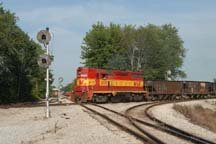
We headed for Spencer, Ohio, where the W&LE has a diamond and heads in four different directions. Our train showed up at Spencer with one of two high-nosed GP38s in the Wheeling red and yellow in the lead, and a locomotive in the W&LE's Rio Grande-style speed lettering tagging along on the rear. We chased the train to Hartland Station, catching it a couple of times on the way. After switching at Hartland, it headed westward and we decided to drop down to the CSX main line at Nova to see what was happening.
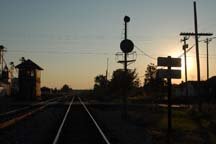
Still standing at Nova is an unused wood-frame Baltimore & Ohio tower, and we hoped for a westbound train before the sun set. Alas, the train showed up just after sunset, but we were able to get pleenty of glinty light images of the tower before calling it a day. It had been a slow morning and afternoon, but the evening was worthwhile.

July 17, 2006
We actually had some "insider" information on the Wheeling's operations on this day, and our source told us that a westbound would be out of Mingo Junction in mid-morning. We headed for the big trestle at Valley View, but according to our calculations it would be close. We got to the trestle at about 11:00 (the train was departing Mingo at 10:30) and waited. And waited. Did we miss the train?

We heard a track foreman get permission to work between milepost 105 and Smithfield, just west of our location. Sadly, we figured our train must have gotten by us and had passed MP 105 (we were at 96), so we trudged back to the car. As soon as we got to the car the scanner came to life as the train we were looking for was just passing milepost 94! We reced back through the briars and brush back to trackside and got our train with a high-nosed GP38 in black and orange on the point with two more black and orange units on the rear. (Actually, the lead unit was not providing any power -- the conductor was riding that unit to work the lights, bell and horn. The engineer was in the trailing units, which were doing all the work pushing the train.)

The chase was liesurely, to say the least, and we caught the train a few times (including passing the station at Weems) before it reached the Ohio Central at Jewett. At Jewett the train reversed directions onto the Ohio Central for the run to Miller's Station and Nelms No.1. Another Wheeling train was coming east on the Ohio Central heading for Mingo Junction, but the dispatcher stopped him at Jewett "for two or three hours" so a rail train could get some work done.

We found the rail train near Pittsburgh Junction, and shot it as the crew called it a day. The rail train then headed to Wayco (milepost 105) to tie up for the night. With the rail train out of the way, or last shot would be of the eastbound passing through Pittsburgh Junction at sunset.

July 18, 2006
The first day of the Convention started off with a trip from Dennison, Ohio, to the Ohio Central's interchange with Norfolk Southern at Gould Tunnel (just west of Mingo Junction). We were joined by John Dziobko, Jr., for the chase, and Frank Ferguson and Mike Burkhart tagged along behind us in their car. We were somewhat dismayed when the excursion left Denniosn with an Alco C420 running backwards leading the train, so we didn't make a real effort to get ahead, although we shot it at Bowerston, Scio, Jewett, the big cut near Cadiz Junction and Miller's Station.

At Miller's Station we thought a train was going to go into Nelms No.1 after the passenger train cleared, so we waited around for something to happen. Well, nothing happened, so we eventually headed for Panhandle where we discovered our mystery train had just headed up the branch to Apex and was unshootable until it returned four hours later. Oh, well. We followed the route of the passenger train, scoping shots for its return trip, and eventually we waited at the overhead bridge near Reeds Mill for the train to return from Gould Tunnel.
Soon the passenger train came back, now with the C420 properly oriented and trailing an ex-Amtrak F40 (still in Amtrak paint). But our real goal was to get the photo freight that was following. The freight had been put together for photographers on the passenger train to shoot during photo runbys. It wasn't long before the photo freight showed up -- an Alco RS18 leading a string of vintage freight cars, with a red caboose trailing. We chased the train to Panhandle where both the excursion and the photo freight cleared to allow our mystery train from earlier in the day -- an Ohio Central constructioin debris train -- to come off the Apex branch and onto the main to head for Gould Tunnel. As things worked out, the passenger train and photo frreight were going to do photo runbys at Panhandle, so we took off after the debris train and chased it all the way back to Reeds Mill. Once the train vanished into the valley heading for Gould Tunnel, we returned to Panhandle just in time to resume our chase of the photo freight, which was now heading back to Dennison and on to Morgan Run (home of the Ohio Central's shops) while the passenger train went up the Apex branch.

We caught the photo freight several times, finally letting it go at Port Washington as it headed for Morgan Run. We then dropped back to Dennison where the passenger train hadn't yet arrived. We worked back against it, setting up at a big cut near Bowerston. We waited. And waited. And waited some more. After about an hour, Mike headed down to road to get a cell phone signal and called a friend back in Dennison. Sure enough, the train had passed us somewhere between Dennison and Bowerston and was sitting (and had been sitting for 45 minutes) in Dennison. So ended another day.

July 19, 2006
The Convention was visiting the Cuyahoga Valley Scenic Railroad on this day, which operates a former Baltimore & Ohio line from Cleveland through Akron to Canton. A washout on the far north end of the line forced the trip to begin in Brecksville, and it was there that Bruce and I met our guide for the day, Jerry Jordak.


Jerry knows the CVSR pretty much inside out, so the photo opportunities were plentiful as we chased along. A good photo runby was held along the highway just south of Peninsula, and another not-so-great runby was held north of Akron. At Akron the passengers formed a long line in the hot sun to get their box lunches, but the NRHS crew got everyone fed and into the shade or back on the train in record time.

Out of Akron the photo opportunities were still plentiful, and we finished the chase at McKinley Park in Canton where another runby was held. At the station in Canton all the passengers were put on buses to return to New Philadelphia or visit other attractions. We opted to chase the empty train back to Brecksville in great afternoon light, highlighted by getting the train passing the Goodyear blimp hangar at the Akron airport. After arrival at Brecksville we headed for dinner at a Skyline Chili parlor, then headed back to New Philadelphia.
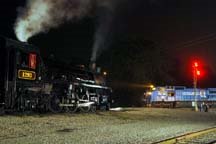

That night the Ohio Central hosted a night photo session at the Morgan Run shops. Ex-Canadian Pacific 4-6-2 No.1293 was the star of the session, and the first shot was of the steam locomotive meeting a Norfolk Southern run-through coal train pausing for a crew change at Morgan Run.
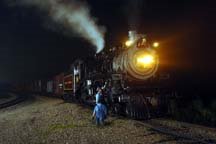
After the coal train departed, Mark Perri and Denis Connell lit up the 1293 a couple more times, and the session ended around midnight with a shot of Grand Trunk Western 4-8-4 No.6325 sitting cold behind the shop.

July 20, 2006
The Ohio Central was again the host for the NRHS as a trip was operated from Dennison to Newark. As was our standard operating practice, we picked up John Dziobko and chased the trip. The first part of the trip found the C420 leading the Amtrak F40, but at Morgan Run both diesels were removed and No.1293 was put on the point for an all-steam trip to Newark. A photo runby was held at Trinway, and as the trip progressed the skies deteriorated. By Newark it was pretty cloudy.

The trip's return was delayed by a meet with a coal train coming out of the power plant at Conesville, requiring the passenger train to hold at Trinway. Since it was stopped anyhow, it was decided to do a photo runby despite the worsening weather conditions. As the train unloaded, rain could be seen comingt in from the west. But it wasn't until lightning struck fairly close by that the runby was cancelled and everyone was put back on the train.

With the steam train sitting at Trinway, we headed to Conesville to find the coal train. We caught it just leaving Conesville and chased it to Dresden, just beyond Trinway (we had a real close encounter with lightning -- a mere 30 yards away hitting a phone pole -- as we shot the train at Adams Mills). Once the train was gone from Dresden, we raced back to overtake the steam train, catching it once at the station at Coshocton before it arrived at Morgan Run and lost its steam engine. With the F40 leading, we shot the train once more at West Lafayette, then headed to Dover to check out the R.J. Corman operation there.

That evening Bruce, Frank, Mike and I (after dinner with other members of the Wilmington [Delaware] Chapter NRHS) went off looking for the Wheeling's rail train, which we hoped would be tied up at Wayco and available for night shots. Alas, it wasn't to be found (which we found out after driving for over an hour), so we drove another hour up to Minerva where we did a night photo session on Ohi-Rail's power sitting around the yard. It was a very late arrival back in New Philadelphia.

July 21, 2006
I needed to be back in New Philadelphia by early afternoon to attend the NRHS business meetings, but Bruce and I met up with Frank and Mike at Brewster where we had a pre-arranged tour of the Wheeling & Lake Erie's shop (where we found the power off the rail train we had been looking for the previous night). We then hung out near Orrville where we hoped to shoot a Brewster-bound freight, but it never showed up (we must have passed it somewhere between Brewster and Orrville). Bruce then hitched a ride with Frank and Mike, while I headed back for New Philadelphia. That evening I attended the banquet where the guest speaker was Ohio Central property manager (and ex-Chessie company photographer) John B. Corns.

July 22, 2006
The final day of the Convention featured a circle trip over the Ohio Central and Wheeling & Lake Erie out of Dennison. Frank and Mike had departed for home, thanks to weather than had been bad since mid-day of the Newark chase. Bruce and I picked up John and off we went in the rain, getting the diesel-powered train with the RS18 leading at West Lafayette.


At Morgan Run the power was run around the train and 4-6-2 No.1293 was added to the point. Just out of Morgan Run, as the train went up the northeastward leg of the triangular trip routing, a photo runby was held (despite the gloomy wet skies) and we caught the train a few more times before it made a stop for the passengers to buy cheese (yes, that's right) at Pearl. At Sugarcreek the steam locomotive was removed and the Orrville Railroad Heritage Society's GP7 led the train into Brewster.

Out of Brewster, with the GP7 still leading, the trip made a fast run down the Wheeling & Lake Erie on the southeastward leg of the triangle, and we were only able to catch it once on this stretch (thank goodness Pete Swanson and Nick D'Amore were chasing -- they had just missed the train at the spot where we were heading, and if they hadn't been racing out of the location we would have stopped and waited and would probably still be there). At the joint track in Bowerston we caught up with the train as the consist was shuffeld to put the RS18 in the lead for two photo runbys, then it was back to Dennison and the end of the Convention. Talk between the dispatcher and excursion indicated a train would be heading towards Dennison from the west, so we continued eastward and intercepted the train at Newcomerstown. We chased it back through Dennison and on to the big cut at Bowerston before calling it a day.

July 23, 2006
Like the first day of the trip, this last day had the real potential to be quiet. Sadly, that's the way it worked out. We started out by waiting along the joint OC/W&LE track in the morning, hoping to get something. Nothing came. Back to Mingo Junction, and everything was quiet there. I had never been to Benwood Junction, so we checked that out. Quiet. We did find the place where the Wheeling & Lake Erie crosses Norfolk Southern on a diamond in Bellaire, and a dead locomotive in Canadian American paint at Warrenton provided just about all the entertainment we'd get all morning and into the afternoon.

Looking to head east, we headed for Meyersdale, Pennsylvania, where the ex-Western Maryland right-of-way over Salisbury Viaduct is now a bike trail. The bridge provides a panoramic view of the ex-Baltimore & Ohio main line, so we went there hoping to see something on CSX. After waiting over an hour, we got an eastbound train, and a westbound soon came by. Just at sunset, as we were crawling through the brambles back to the car, we heard another eastbound and raced to Meyersdale to shoot it. Sunset marked the end of the trip, save for a long drive home through the darkness on the Pennsylvania Turnpike (which is largely built on the right-of-way of the partially constructed South Penn Railroad -- but that's another story for another time).

Convention Notes
Buckeye Rails 2006 was a largely unspectacular convention by necessity; with no Chapter stepping forward to host the 2006 Convention the event was run by the NRHS National Convention Committee, headed by Carl Jensen. As such, the staff for the event came from all over the U.S., and much of the planning had to be done via e-mail and telephone, with little on-site planning. Therefore, a simple Convention was planned. The other side of the coin is that the Convention was extremely well executed, with no major delays, no bus snafus and no food shortages. Kudos to the Convention staff for pulling off a well-run event despite all the logistical hurdles. Now it's on to Chattanooga for 2007!

Thursday, July 13, 2006

Genesee Railroading

All the images from this trip can be viewed in Photologues. Use the link at left.

When the Rochester Chapter of the National Railway Historical Society asked me to put on a program for their annual banquet, I thought it would be a great opportunity to transfer one of my multi-media slide shows to digital (taking advantage of my relatively new digital projector), so armed with my revised Up From the Apple show and my new Steaming Along program, I was Rochester-bound.

June 10, 2006
The weather was dull and overcast as I hit the road, following the ex-Erie main line along the Pennsylvania-New York border towards Binghamton. The dull weather meant I wasn't in any particular hurry to get trackside, so a bit of exploring was in order. My first stop was at the ex-Erie depot in Coshecton, New York, recently restored by the local historical society.

As I passed through Hancock, I realized I hadn't checked out the former New York, Ontario & Western depot in the nearby town of Cadosia in quite awhile. Once a major junction point on the O&W, Cadosia was where the coal line from Scranton joined the main line between Cornwall on the Hudson River and Oswego on Lake Ontario. The tracks have long been gone from Cadosia, and on my last visit the depot (converted to a bar) sat in a big open area next to what was once the marshalling yard for the O&W's coal trains. It took me a few minutes to find the depot on this trip, as the empty abandoned yards that surrounded the structure 20 years ago had grown in with trees, and I didn't recognize the area immediately. But soon I was at the depot (now a garden center) and noted that the freight house was also still standing. A large trestle had stood just behind the depot with a view down into Hancock, but growth has obliterated the view.

Next up was a stop in Binghamton, where a local freight for the New York, Susquehanna & Western was cutting locomotives out of the consist just south of town. They had some work to do, so I buzzed across the Susquehanna River to Conklin Yard (former Delaware & Hudson, now Canadian Pacific) where a coal train was backing in. A quick run down to Terrace Drive on the south end of the yard led to the discovery of a couple of switchers working, then it was back to the NYS&W, where the local freight was now ready to head into Binghamton. I caught it passing an eastbound train that was tied down waiting for a crew.

I had wanted to shoot the Susquehanna's passenger operation in Syracuse, so my next stop was at OnTrack's Syracuse University station, where I caught the Rail Diesel Car making its scheduled 2:20 p.m. stop. Thing was, it wasn't turning back to Syracuse like it was scheduled to, but instead was heading to the balloon festival at Jamestown Beach. The railroad was running special trains all day (no mention of this was made on their website when I had checked a few days earlier -- in fact, the schedules on the website, the schedules posted at the stations and the actual "official" schedule were completely different from each other). Not wanting to get caught up in balloon traffic, I headed west of Syracuse along the ex-New York Central (now CSX) main line and caught a westbound train (after heading all the way into downtown to the main OnTrack station to check the balloon festival schedule, since it wasn't posted at the outlying stations) then headed back to Jamesville (norrth of Jamesville Beach) to await the last northbound festival run. The local police were doing a booming business in Jamesville, picking off unsuspecting ballon fans as they passed through the town's speed traps. Much to my surprise, the northbound train wasn't the RDC's but was instead a locomotive-hauled passenger train. Duly recorded, I decided to head back to my spot on CSX west of town and shoot trains until dark, then make my way to Rochester.

As I headed west, I noticed the solid bank of clouds appeared to end farther west, so I decided to drive until I reached sun and then stop. By the time I reached sun, I had covered about half of the 60 miles between Syracuse and Rochester, and a quick check of my watch indicated that I could get to downtown Rochester by 6:00 and attempt one of my "priority" shots of the trip, a CSX train crossing the Genesee Falls in downtown. Off to Rochester!

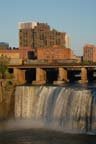
Once I arrived at the falls, I was pleased to see that a lot of the seediness that I remembered from a previous trip had vanished. A nice park led to the footbridge that parallels the CSX bridge over the falls, and provided a very pleasant train-watching spot. CSX fully cooperated, and it wasn't long before I had three trains shot crossing the bridge. With that shot in the bag, I decided to try a couple of other spots recommended to me by local railfans, and headed towards the Main Street overpass at the west end of Goodman Street Yard. Once again CSX cooperated, and I had that shot accomplished in short order. back to the falls for one more train, then up to the Amtrak station (just east of the falls bridge) to shoot an Amtrak train just after sunset. Time for bed.

June 11, 2006
First quarry this morning was a shot of a train passing the Kodak building in downtown Rochester. An early morning eastbound Amtrak train was selected as the target, but arrival at the shot (just west of the falls bridge) was in time to get a late-running Lake Shore Limited in addition to the train I was seeking. With that shot accomplished (twice) I cruised around re-aquainting myself with Rochester, a city I hadn't visited for about ten years. Driving around, I eventually settled on CP 367 in the town of Brighton, just east of downtown and within sight of the east end of Goodman Yard. A train or two later and it was time to leave.

I was meeting Chris Hauf of the Rochester Chapter at the group's Rochester & Genesee Valley Railroad Museum in the town of Henrietta at a location known as Industry, where the Chapter has restored the Industry depot. Chris gave me a tour of all the Chapter's equipment and the restoration shop, then I rode a track car (can't call it a "speeder" because you'll scare the general public, even though it never tops five m.p.h.) over a mile and a half of track to another museum, the New York Museum of Transportation. While the R&GV Museum is devoted to the freight and passenger railroads of the region, the NYMT is more geared to streetcars and other non-rail transportation modes. I returned back to Industry on the speeder, then returned to CP 367 for some more CSX and Amtrak action (some of it even in sun!) before heading off to the banquet to put on my shows.

After the banquet I decided to try some night photos at CP 367, as it is guarded by two New York Central style signal bridges, complete with searchlight signals, at both ends of the interlocking. I caught two eastbounds side-by-side at the west end, then headed over to Goodman Street Yard for a couple of shots, then finished off with a westbound passing an eastbound at the east end of the interlocking. Another day in the bag.

June 12, 2006
The weather forecast for the next two days was bad, so I decided to cut the trip a day short and not head into Buffalo for a day of shooting. Instead, I got up at the motel (located just a few miles from the museum in Henrietta) and set out for Lakeville, home of the Livonia, Avon & Lakeville Railroad. A quick check at their office revealed that a train was heading for Rochester, so I headed back north and set up next to the museum building at Industry to get the train's passange. Been on the road for over an hour and I was only five minutes from my starting point. I continued the chase (there were two four-axle Alcos leading the train) to the south end of Rochester, then turned west with the railroad to Genesee Junction, where I somehow lost the train. Thinking that it might have turned south at the junction (it was supposed to go north to the Buffalo & Pittsburgh yard at Brooks Avenue, but it didn't appear that happened) I headed south as well. No sign of the train. Oh, well...

The tracks of the Dansville & Mount Morris appeared along the freeway as I headed south, and I decided that more exploring was in order. I got off the freeway and looked for any power the D&MM might have in Dansville. I didn't find power, but I did find the old passenger depot, located about a half mile below the current end of track. Thinking the power might be at the B&P interchange seven miles north, I followed the railroad to the interchange point, only to discover there was no yard (or power) there -- just tracks in the trees. Heading back to Dansville, I checked out what is probably the only customer on the railroad, the Foster Wheeler plant. If the railroad had any power, it was probably tucked inside the plant somewhere. Back on the road...

Next up was the B&H Rail shop in Cohocton, New York. I couldn't find anyone around to check in with, but I did find an ex-Minnesota Commercial six-axle Alco and a Bath & Hammondsport Alco switcher sitting outside the shop. Amazingly, the only sun of the day came out while shooting the two units together.

After passing through Bath I started keeping a watch out for the Bath & Hammondsport train that might be returning from the Norfolk Southern interchange at Gang Mills. Sure enough, I spotted the westbound train as I sped eastward on the freeway about seven miles outside Bath -- and I had just passed a freeway exit. I had to drive another five miles and then double back, but I was able to shoot the train (once again with two Alcos on the point) twice outside Bath and once passing the coal silos in town. The day was waning.

Passing Gang Mills yard, I heard a train on the radio get permission to pull up to the yard office. Then the dispatcher warned the crew to watch out for a westbound train that should be there by the time they reached the yard office. I got through Corning (the big town next to Gang Mills) and heard the radio announce the train's passing of a defect detector, which also announced the train's location. I could see the tracks as I drove along and -- there -- a milepost indicated that I was about four miles from the train and closing. Thankfully, there was an exit just a mile ahead that featured an overpass over the railroad, and I wasn't there long before bagging a westbound Canadian Pacific train operating over Norfolk Southern. Continuing eastward, I was passing the town of Owego when I heard another westbound calling signals. I got off at the next exit and U-turned back west for a 14-mile backtrack to Smithboro, where I caught the last train of the trip with Norfiolk Southern power.

A final check at Binghamton revealed nothing shootable at either end of Conklin Yard, and a return along NS down the Delaware River presented nothing before darkness set in east of Hancock. The trip was over.

Monday, July 10, 2006

Eastern Pennsylvania - Steam and Main Lines

All the images for this entry can be found in Photologues. Use the link at left.

With a few days to do some short trips from home, I headed into Pennsylvania to check out the action.

May 20, 2006 - Steamtown to East Stroudsburg
For Armed Forces Day, Steamtown National Historic Site operated an excursion beyond its usual route between Scranton and Moscow, traveling all the way to East Stroudsburg. Canadian National 2-8-2 No.3254 was scheduled to pull the trip, so I headed to Scranton in time to chase the departure.

The scanner came to life as I approached Scranton, but ominously I could hear the crew calling the train as "Nickel Plate 514." This would indicate a diesel was on the point. Sure enough, upon my arrival I discovered that Nickel Plate GP9 No.514 would be ahead of the steamer for the trip, the reason being that the 3254 had just come out of the shop after a lengthy repair and didn't have its road-worthiness tested. The diesel would be an insurance policy against a mechanical problem.

With the diesel on the point, I decided to let the excursion proceed without me in pursuit, and instead visited the Steamtown shop to check on the progress of Pennsylvania Railroad 4-6-2 No.1361, Boston & Maine 4-6-2 No.3713 and Baldwin Locomotive Works 0-6-0 No.26 (and to check out how my new Nikon D200 handled interior shop lighting). All were in various stages of disassembly, with two workers heating what appeared to be the tender frame of No.26 with acetylene torches. Work on all three locomotives has apparently progressed past the teardown point, and re-assembly (a time-consuming process) has begun. Nonetheless, I wouldn't anticipate seeing any of the three locomotives operating until sometime in 2007 at the absolute earliest.

After the shop visit I took off after the excursion, as the plan was to remove the diesel at Gravel Place (about three miles outside East Stroudsburg) and have steam make a grand entrance into town. As I passed Tobyhanna on I-380 I heard the excursion just leaving its servicing stop there, so I motored in to Devil's Hole to get a shot there. After Devil's Hole, I checked out the shot passing the concrete signal tower at Gravel Place (no shot there due to heavy brush) and headed into East Stroudsburg. Sure enough, the diesel had cut away and the large crowd in attendance got a good look at No.3254 as it pulled the train into town.

Since it was only around noon, I headed down to the New Hope & Ivyland to check out 2-8-0 No.40. The locomotive had been painted and lettered for the "Lancaster & Chester" (a South Carolina short line that owned No.40 at one time) for a set of winter photo charters, but was scheduled to be painted back into its New Hope & Ivyland scheme. While I had numerous shots of it lettered L&C on freight trains, I didn't have any of it lettered L&C on a passenger train. The New Hope shop forces had been busy, however, and upon my arrival I discovered that the L&C lettering was already a thing of the past. Nonetheless, I shot No.40 a few times before calling it a day.

May 27, 2006 - PicnicRail
Each year I'm asked to put on a slide show at PicnicRail on Memorial Day Saturday. PicnicRail is a joint picnic involving several Chapters of the National Railway Historical Society (Hawk Mountain Chapter's Phil Reppert is the organizer) and several other railroad historical societies. It's held in Blandon, Pennsylvania, just outside Reading, at a picnic grove directly adjacent to Norfolk Southern's former Reading Company main line.

Starting out from New Jersey, I spotted some Norfolk Southern power beneath the Delaware River bridge in Portland, Pennsylvania, so I made a brief detour to shoot it. Then it was off to Fleetwood on the NS main line, where the town's historical society has restored the "Fleetwood" lettering to the end of the old Cadillac Fleetwood body plant along the tracks. back-to-back westbound freights and an eastbound passed through town, then my brother (who had driven up from South Jersey) and I moved one town east to Lyons. On the way I heard a westbound train on the scanner and sped down to the tracks, only to discover it was a light engine move running in reverse -- not the most photogenic subject! The trailing unit was a BNSF Railway GE locomotive, but there was no good going-away angle available where we were.

Once in Lyons, we shot an eastbound train led by a Union Pacific locomotive, and a couple of NS westbounds appeared. Also the light engine move re-appeared, this time running east but still running backwards -- apparently the power had run from Allentown to Reading to be turned and was returning to Allentown. This time, however, we had a well-lit going-away angle to shoot the BNSF unit.

With traffic dying down and the sun setting, it was time to head to Blandon and the picnic. Great conversation and a barbeque chicken dinner were had by all, and after the slide show it was time to head home.

May 29, 2006
Let's get one thing straight right away -- Memorial Day 2006 was hot! Nonetheless, the forecast was for sun, so I decided that perhaps a visit to a tourist railroad might be in order. I hadn't checked out the Lehigh Gorge Scenic Railroad, the new (in 2005) operation of the Reading, Blue Mountain & Northern, so I headed for Jim Thorpe.

A quick stop at the station was made to photograph the LGSR train sitting in front of the former Central Railroad of New Jersey depot, and the F3 diesels owned by the Anthracite Railroads Historical Society and the Tri-State Chapter of the National Railway Historical Society (and used in tourist service in Jim Thorpe until 2004) were also committed to film. Then it was off to Glen Onoko, the southern gateway to the Lehigh Gorge. Two railroads shared the gorge at one time -- the Lehigh Valley, which is now used by the Reading & Northern/Lehigh Scenic as well as Norfolk Southern, and the now-abandoned Jersey Central. The CNJ roadbed is now a hiking/biking trail (and quite popular), and provides great access for photography along the former Lehigh Valley.

The first train departed Jim Thorpe at 11:00 a.m., and I shot it framed by some trees just north of Glen Onoko. The LGSR operates with two Reading & Northern SD50s, one on each end, so I tried to choose locations that provided a good going-away shot as well as a standard comin'-at-ya. The train headed into the gorge, and I continued walking north, stopping at a nice location where the tracks curve past a signal. I shot the returning 11:00 train there.

With over an hour to kill until the next train appeared, I stopped at a convenient picnic table and finished off the bottle of water I had brought with me (did I mention it was hot?). I then walked further north and found a nice retaining wall where I could shoot the 1:00 train coming and going, which I did. With about 30 minutes between the time the northbound 1:00 train passed and its southbound return, I continued walking north, but soon discovered that the tracks curved to the point where the sun was on the wrong side for photography, and the line continued to be elevated on a retaining wall, precluding crossing the tracks to the sunny side. I soon hit a point walking north where I calculated that I couldn't return south in time to get to a good photo location, so I was committed to walking north and hoping I could find a good photo spot before the train showed up.

I was walking at a fairly brisk pace (did I mention it was hot and I had finished all my water over an hour ago?), hoping to reach Oxbow Curve where the tracks would curve back to a more favorable sun angle. Alas, I was about five minutes too short, and had to settle for a not-too-bad shot of the train exiting Oxbow (although the going-away shot was lousy). I was now finished with the 1:00 train and just had too wait for the 3:00 train a little over an hour away.

Now it was reality time. I had walked in over two miles from Glen Onoko and had to work my way back. I trudged out of the gorge and back to my car, where I thirstily guzzled a very hot bottle of Diet Coke (at least it was wet) before walking into the large bridge over the Lehigh River at Nesquehoning Junction for the 3:00 train.

The tower guarding Nesquehoning Junction had been covered by heavy brush for years, but when the Reading & Northern re-opened the Lehigh River bridge to freight traffic a couple of years ago, they removed the brush from the abandoned tower. Alas, it didn't take the local urchins too long to discover the now-clear walls of the building and it is now covered in graffiti. I opted for a distant shot of the tower from the east side of the Lehigh River, where I captured the outbound 3:00 train. I then drove into downtown Jim Thorpe, bought a bottle of Gatorade and a bottle of water, chugged them both down, and shot the returning 3:00 train passing the F3s in the Jim Thorpe yard, wrapping up a great day of tourist line shooting.

Tuesday, July 04, 2006

A Canadian Encounter

All the images from this trip can be viewed at Photologues. Use the link at left.
Every year I take a trip with George Pitarys and Bill Linley to somewhere in eastern Canada, with George planning out the complete itinerary. It's one of the few times each year where I'm truly along for the ride with no worries about logistics -- George has it all planned out. Our 2006 schedule included visiting the Huron Central, chasing VIA's Canadian and riding the VIA Rail Diesel Cars between Sudbury and White River, Ontario.

Prologue
I have a lot of last minute proof-checking to do on the current issue of Railfan & Railroad, so I don't get away from the office until after 7:00 p.m. on Tuesday, May 9. A late drive gets me to George's house near Nashua, New Hampshire, at about 2:00 a.m. Since our scheduled departure time is 4:00, a motel is definitely not worth it. Not wanting to disturb George, I pull over in a parking lot about a mile from his house and get some sleep.

May 10
My cell phone rings at 3:20 a.m. Sure enough, it's George. He's up and ready to go. I drive the couple of minutes to his house (after de-grogging myself), we transfer my gear to the rental car, and we're away before the 4:00 schedule. Our first stop is a solid seven-hours-plus away -- we want to catch the Ottawa Central as its freight makes its return trip from Pembroke to Ottawa on the Ottawa River bridge at Portage du Fort, Quebec. An uneventful border crossing into Canada, and we're soon in cell phone contact with the third member of our group, Bill, who's been chasing the freight with Ray Farand and Dave Stremes. Our schedule is looking good -- we'll be at Portage du Fort well before the train.

We all rendezvous at the Smurfit-Stone plant in Portage du Fort, where another Ottawa Central crew is working. Soon we're off for the short walk in to the Ottawa River bridge, and a slightly longer walk downriver to improve our photo angle. The train, powered by two ex-Canadian Pacific RS18s, crosses the bridge in good sunlight (not bad with a forecast that had called for clouds and rain), and soon we're piling Bill's gear into the rental car and bid farewell to Ray and Dave.

With some sunlight to burn still, we head down to the Canadian Pacific, where we chase a train eastward, finishing with a nice shot at Pakinham, Ontario, across a field dotted with yellow dandylions. But the train is heading east and we need to head west (we have a reservation in North Bay, Ontario, four hours away) so we leave our eastbound to resume our journey. We do bag one more eastbound on the way, however.

May 11
The traditional stop at Tim Horton's gets the day started, and soon we're off to Parry Sound to get set for the day. A stop on Canadian National on an old wooden overpass yields four trains, but our info (thanks to a CN sectionman who stopped and gave us a rundown) says nothing more is due for a few hours when VIA's westbound Canadian is due. This gives us a chance to grab some maple ice cream and scope out our set-up point for VIA.

The Canadian is our top priority for the day. A one-time Canadian Pacific train, it retained its CPR routing into the VIA era. Alas, VIA decided eventually decided to route the train over the Canadian National in central and western Canada, taking the train off its historic route. However, CN and CPR utilize directional running on their parallel lines between Parry Sound and Sudbury, and thus the westbound Canadian runs over its original route on this stretch.

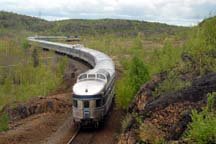
Our chase begins at Nobel, where trackwork brings the train to a brief stop, allowing us a second grab shot almost immediately. Photo locations are picked to allow both good comin'-at-ya shots and going away shots, taking advantage of the round end observation car Waterton Park on the rear. The bridge at Pointe au Baril is good, but while looking for a place to turn the car around (after getting the shot) we find an even better shot 100 yards up the road. Add that one for later in the trip. We bag the train a few more times on the CPR, with the last at Rutter. By Sudbury Junction the train is back on the CN and we're in a downpour. The planned rest of the chase to Capreol is scrubbed due to weather, and we're soon esconsed in our hotel room at the Sudbury Quality Inn with a good view of the CPR yard and the parading hookers on the street below.

May 12
This was a day where the Huron Central was our primary goal. We could see the Espanola Turn being made up in the yard from our motel room, and soon we were set up at Copper Cliff (in the rain) waiting for the westbound move.

The trip goes well, with several good shots in the clouds (at least the rain is letting up) along the way. The crew was getting used to seeing us, and near Nairn where they were switching a spur we could hear the conductor on the scanner (riding the rear car) tell the engineer, "Three cars to the photo op." After working the spur, the locomotives pulled to a stop next to us and we're able to give the crew copies of the latest Railfan & Railroad, which includes an article on the Huron Central.

Upon arrival at Espanola, its time to start thinking about bagging the eastbound Canadian. We think we can make it to the ghost town of Milnet, and scanner chatter says there is a train coming. Sadly, the train coming is a freight -- we missed the Canadian and had to beat feet to get ahead of it during its servicing stop in Capreol. Crossing the tracks at Capreol, we are relieved to see the train still there (we can try this shot again in a couple of days), but we still have a challenge. The shot we want involves a bit of a walk and climbing some rocks, so we head towards Coniston.

Once at Coniston, we scramble up the rocks and get set. We don't wait long for 22 cars of stainless streamlined beauty to come past. Bill, who has been rather diligent about getting going-away shots of the Canadian this trip, for some reason decides not to scramble over rocks with me and George to get this going-away shot, and somehow misses the shot of the trip, the Banff Park observation car with the rest of the train snaked through an S-curve.

With the Canadian out of the way, we head back on the Huron Central to pick up the road freight working east from Sault Ste. Marie towards Sudbury. The scanner soon has us triangulated in on the train, which features matched GP40s in numerical order on the head end -- 3010, 3011, 3012, 3013. Somehow the comin'-at-ya shots are in clouds while the going-away shots are in sun. Soon we're back in Sudbury, but we're too late to get the VIA RDC's coming in from White River. We head into town and see the RDC's leaving as they deadhead back to Capreol for the night. We'll be riding these cars for the next two days to White River and back.

Alas, we get some bad news (fairly serious, but nothing with long-range implications) that evening that will require us to return to the United States, cutting our trip short. We make all the appropriate phone calls to cancel reservations for the remainder of the trip.

May 13
Today is a book-home day, but a couple of trains fall into our laps and are duly recorded. We overtake an eastbound CPR freight at Mattawa, Ontario, just in time to get him passing the CPR depot there. Another eastbound is tied up at Chalk River and we shoot him. Bill gets dropped in Ottawa, and just before crossing the border George and I encounter Amtrak's northbound Adirondack stopped for its customs inspection at Cantic, Quebec. We arrive at George's house late that evening, and I don't even consider trying to push the extra five hours to New Jersey.

May 14
The weather doesn't cooperate as I head across Massachusetts and Connecticut, but I need to see something on this final leg of the trip, so I pull into Danbury, Connecticut, hoping to find one of the last FL9s in the yard. It was not to be, so a shot of a Genesis unit next to Danbury's old depot (now home to the Danbury Railway Museum) is all I get before making the final push home.

Spring In the Southland

All the images taken on this trip can be viewed in Photologues. Use the link at the left

I was invited to help out with a night photo session at the North Carolina Transportation Museum in Spencer for its Railroad Days in early May. A trip to the southland in sping is always welcome, and besides I had a new toy to play with -- a brand new Nikon D200 digital camera had replaced my fleet of Nikon film cameras.

May 5
I didn't get out of work as early as I would have liked, although bad weather made me a little less than motivated to make a rush. Finally I was out and heading down I-78 in late afternoon. Wanting to give my new D200 a test, I stopped before darkness set in at Hershey, Pennsylvania, where I could view the Hersheypark monorail crossing over Norfolk Southern's ex-Reading main line. After an hour of watching the monorail trundle back and forth, I decided to relocate to the Derry Road grade crossing, where scanner chatter indicated I might see a local working the small yard there. While the local wasn't visible, I did get back-to-back eastbound freights before resuming my drive.

The initial plan was to drive to Harrisonburg, Virginia, and call it a night. Unfortunately, it was graduation weekend for James Madison University and not a room was to be found. I pressed on to Staunton, where I ran into garduation weekend for the University of Virginia in nearby Charlottesville. I eventually pushed on to Roanoke, finally getting a room at 1:00 a.m.

May 6
One good thing about being in Roanoke is that it's a great town for watching trains. After sunrise I went downtown where I caught a light engine move and a caboose hop passing near the former offices of the Norfolk & Western Railway. From there it was off to Virginia Scrap Iron & Metal to photograph the "Lost Engines of Roanoke." This scrap yard contains four ex-N&W steam locomotives, as well as two Baldwin-built diesels that used to work for the Chesapeake Western. Trees obscured three of the four steamers, but the fourth steam engine and both diesels were duly committed to film -- uh, make that pixels, as I was now a digital shooter (for more on the Lost Engines, see the Land of Link entry below). The final stop in Roanoke was at the ex-Virginian Railway depot, gutted by a fire a few years ago. (As a side note, all six of the scrap yard locomotives and the Virginian depot are in varous stages of being preserved).

Now it was time to head to Spencer. I hd been to the North Carolina Transportation Museum's Railroad Days each of the previous three years, and I hoped that they had a surprise or two in store for this year. I was not disappointed, as they had a former Norfolk & Western GP9 pulling an all-Tuscan red passenger train -- an N&W local train straight outy of the early 1960s! Also running was a former Southern Railway FP7 pulling an all-Southern passenger train, and a diesel built by Fairbanks-Morse that last ran on the Beaufort & Morehead's port railroad pulling a string of cabooses (cabeese?).
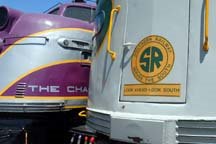
There was also a fine display of motive power around the turntable, including passenger E-unit diesels from the Southern and Atlantic Coast Line.


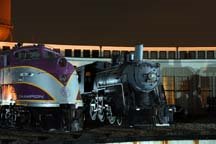
The forecasted rain had held off, and after a fine afternoon of shooting the three museum trains, it was time to set up the night photo session. The fine folks at the museum let me decide what scenes to shoot, so we wouind up shooting both the N&W and Southern passenger trains in the big field south of the museum's shop buildings. From there it was off to the roundhouse to shoot the power on the radial tracks (my favorite scene being the ACL E-unit side-by-side with an ACL 4-6-0 steam locomotive -- two generations of ACL passenger power.) The final scene featured the museum's Baldwin-built AS616 painted for the original Norfolk Southern alongside a modern diesel provided by the current-day Norfolk Southern. It was a late night, but a fruitful day.

May 7
The rain finally arrived, and Sunday morniong started out gloomy and wet. My first stop was just north of Spencer where I photographed Amtrak's northbound Carolinian crossing the Yadkin River. A little farther north in Lexington I caught Amtrak's state-sponsored Piedmont heading south, as well as a northbound freight. Hitting the road, I thought I was ahead of the freight near Ruffin, but I wasn't. As a consolation prize, however, I heard him meeting a southbound freight on the scanner, and the southbound made for a nice shot passing a set of signals.

Next stop was Danville, Virginia, where I stopped at Dundee Yard near a small engine facility. When the tower operator (probably the yardmaster for the nearby yard) walked past, I asked if he had anything coming. He responded that a northbound would be on the scene in about 20 minutes.

I relocated to a small wooden bridge over the tracks just north of the tower, and sure enough the northbound showed up. Alas, he had work to do in the yard, and by the time he was ready to proceed over an hour later the weather had deteriorated to a downpour. This put the new digital camera to the test, but I was able to capture images in the dark rain that would have been impossible with film. I then headed towards Lynchburg, but scanner chatter indicated that I had overtaken my northbound, so I left the main highway and headed in to the tracks near Evington, where once again I captured the train in the rain.

With the day hustling by and the weather showing no signs of improvement, I decided to cancel my planned stop at Lynchburg and head for home. Fastest way back seemed to be to take U.S. 501 over to I-81, so that's what I did. I didn;t check the map real careful, however, and was pleasantly surprised to discover that U.S. 501 paralleled the former Chesapeake & Ohio (now CSX) Jame River Subdivision. Just as the road joined the tracks an eastbound train went past. Drat! But the scanner gave a hopeful sign when I heard the eastbound exchange pleasantries with a westbound in a siding. Great! I had a train heading the same way I was just behind me.

I checked the map and picked out what looked like some good photo locations where the tracks, road and James River all came together. I passed up a few good locations on my way to the picked-out spots, only to discover I should have stopped. The location I picked based on the map had the tracks and road separated by a lot vertically (i.e. the tracks are down there through the trees over that cliff). I finally settled for the train passing the steam-era coaling tower in Balcony Falls.

From here the only other stop would be near Natural Bridge at Foam Henge, a full-scale replica of Stonehenge made from styrofoam blocks. Then it was onto I-81 for a ride home in a downpour all the way.

Thursday, February 24, 2005

Canadian Birthday

Last week I posted a trip report that was the first of two trips tied into a 50th Anniversary of sorts. Less than a week after getting back from the O. Winston Link celebration in Waynesboro, Virginia, I was off to the Great White North (cue Doug and Bob MacKenzie) for a surprise 50th birthday party for Greg McDonnell.

PROLOGUE
After dinner on Thursday, January 27, I leave Newton and drive to the Scranton (Pa.) airport. There I meet my brother Bruce who has driven up from southern New Jersey. We leave his car in the long-term lot at the airport and continue on to Gang Mills, New York, for the night. I have a cold, but I never know if it's going to go away the next morning or not (when I catch a cold, it usually passes quickly). I am armed with NyQuil for the night, however.

JANUARY 28
The Weather Channel says it's -9F in Elmira, and the bank clock in Tioga says it's -10F as we head out early in the morning from the EconoLodge in Gang Mills. My cold has gotten slightly worse, and my nose won't stop running all day. First stop -- Wellsboro, Pa., for a look at the Wellsboro & Corning. We arrive at the Wellsboro station at 8:00am. just as the crew is coming on duty. They say they only have about 45 minutes of switching at Osram Sylvania in Wellsboro and that will be it for the day -- no run along the scenic main line past Hammond Lake to Gang Mills today. Oh, well... It's a sunny morning, but the Osram Sylvania plant is generating a razz cloud that just happens to be between the wide-open snow covered tracks in front of the plant and the sun. A few shots and the train is done for the day. We're off again.


Next stop is Bath, New York, seeking out the Bath & Hammondsport. After poking around town for awhile, we spot a train heading for Painted Post with four-axle Alco Centuries on each end of the train in pull-pull mode. The chase is on, and we get nice shot of the train crossing the Cohocton River at Savona, an across the field shot at Coopers Flat and more. Upon arrival at Painted Post (right next to Gang Mills and Corning) we gas up and vittle up while the train switches. The return trip is only light power coupled back-to-back, so we decide to just grab a shot at Coopers Flat and forsake the rest of the return trip and instead shoot the ex-Delaware, Lackawanna & Western station (nicely restored) in Painted post, then head over to Gang Mills to shoot some Norfolk Southern power switching under the bridge at the east end of the yard.

After wrapping up our shooting at Gang Mills, we're off for the Bath & Hammondsport (okay, B&H Rail) shop at Cohocton. In the back of my mind, I had wanted to shoot a train passing the coal silos in downtown Bath but figured it wasn't worth chasing light engines back just for that one shot. Now that we're rolling along Route 17, I keep an eye out and -- there it is -- the light power running just outside Bath. We bail off Route 17, head downtown and set up at the silos with only a four or five minute wait to get the shot. It couldn't have been planned any better!

Now it's off to Cohocton where, after signing releases, we're happily photographing ex-Cartier Alcos. Upon check-out at the office, the head of the B&H's track department is thumbing through the recent R&R's I had dropped off he and starts giving me a hard time. "Every shot is of trains," he says. "If you published shots of track workers, I'd subscribe!" I quickly filled him in on Charlie Dischinger's article on BNSF's maintenance blitz on the Thayer Sub, but he's still razzing us. When I get back to the van I remember the milk crate I have filled with back issues of R&R that have accumulated in the van. I quickly start running through them and third issue down in the bin in the issue with Charlie's article. That was easy. I run back inside and give him the issue. He laughs and says, "Now I have to subscribe!"

Once we're done at Cohocton we realize the Arcade & Attica is probably finished for the day and the only chance of seeing a moving train is going to be up at the Water Level Route near Rochester. We get there at about 4:00pm and park near North Chili, but the sun sets before we see anything. An uneventful crossing into Canada, and we're at the Comfort Inn at Burlington, Ontario, by 8:00pm. NyQuil, NyQuil...

JANUARY 29
I can't move. For 30 minutes after the alarm goes off I just lay in bed. Everything is in celsius degrees on television and it all begins with a "minus." Cold. The runny nose has stopped, but now I have a slight fever. Lake Ontario is generating a light layer of razz, but we spend the morning shooting VIA and GO Transit, plus an Amtrak train, near Oakdale and Mississauga. Nothing spectacular. Soon it's time to head to Orangeville for the event that we're in Canada for.

Greg McDonnell celebrated his 50th Birthday on Christmas Day 2004, and some of his railfan friends (promarily Steve Bradley and Jim Brown) thought it would be a good idea if we had a railroad surprise party for Greg. The passenger train on the Orangeville Brampton Railway was chartered and by 12:30pm the single coach behind an ex-QNS&L GP7 is filled with Greg's friends. Greg had been invited to "lunch" at the Orangeville station (now a fine restaurant) and on the way he received a cell phone call saying that there was a charter on the railroad and one of the riders had bought one of Greg's books and could Greg swing by to give a quick autograph. Greg obliged, and we all sort of hide (i.e. keet our faces out of the coach windows) when Greg arrives. He gets on the coach, where he sees a couple of people who "should be there" such as engineer Steve Bradley. But as he looks back through the coach, he sees that he knows *everybody* on the train. The surprise had come off without a hitch!

Once Greg and Maureen are on board, we take off for Brampton, stopping for photos along the way. The surprise has been so complete that Greg has no coat or boots so he can't get off for the numerous photo runbys. He has to scrounge up a notebook, pen and watch so he can keep notes during the trip. With numerous photo stops on the way down to Brampton a good time is indeed had by all. The ride back is non-stop, so I use the time to sleep, trying to take care of my cold.

Once back at Orangeville, the fun is only getting started. The entire group heads over to the train station for dinner and entertainment. Stan Smail is the de facto master of ceremonies, and after dinner he displays his songwriting and singing abilities with tunes he wrote such as "Binghamton" and "Dominion's Dream." At 9:30 the slides start, but I have to beg off. It's been a fun evening, but I need some sleep to get rid of the cold, so Bruce and I return to Burlington. More NyQuil is consumed.

JANUARY 30
I'm up 30 minutes before the alarm goes off, and the first thing I notice is my nose is clear and I'm wide awake. Sunny skies outside have me feeling almost 100 percent, and we head for Bayview Junction for the morning. We start off with a westbound VIA train (and my first and only Spider-Man F40) from the railfan hillside, and follow that up with an eastbound from the Botanical Gardens footbridge (I notice that the shot works in the winter, with no leaves on the trees -- it would be a much more difficult shot in the summer). We just miss a freight with two Conrail units on the point, and a chase proves futile. A VIA westbound that has an all-stainless steel train is up next, so we shoot off the highway bridge looking up the valley at Hamilton West (the "north" junction of the Bayview wye). The last train of the morning is Amtrak heading from Toronto to Niagara Falls and New York, so we head for the big bridge at Jordan to get him. Our arrival at Jordan is early enough that we have time to shoot the abandoned steel sailing ship in Jordan Harbor before bagging Amtrak. Two CN freights are in the hole for Amtrak, and we get one in Jordan and the other across Jordan Harbor at Vineland. The light wasn't the best for the freights, but our passenger train shooting has been rather productive. An uneventful crossing back into the U.S. follows.

As we cruise past Niagara Falls, we realize our Amtrak train should be sitting in the station enduring its Customs stop. We buzz into the station and have what is unfortunately becoming a part of every railfan trip report -- The Encounter With the Law. We pull into the station parking lot and immediately have a Niagara Falls city policeman on our tail. "You can't take pictures here," he says. I ask why not and he mutters the usual "since 9/11...." line. I reply that I was unaware that the First Amendment had been suspended. He checks i.d. then has headquarters cal Customs inside the Niagara Falls station. A few minutes later two Customs agents come running out, buy once they see the police officer has the perps well under control they slow to a walk. Two more agents soon follow. One agent takes our i.d. and walks back to the station. After a short wait he walks back and hands us back our i.d.'s. "You guys check out," he says. "Go ahead and take your photos." If the station hadn't been such a long walk from where we had stopped, the entire encounter wouldn't have taken more than ten minutes. We shoot a couple of frames and we're literally done in less than a minute. The cop and agents stay. As we leave we say we didn't mean to cause a problem. One agent responds, "Don't worry about it. We need something to do." A quick stop at the CSX yard across from Amtrak, and we're out of town.

Next stop is the small town of Bergen, located on the ex-NYC Water Level Route west of Rochester. The line is hopping, and we soon have a few freights and Amtrak committed to film. A call to Julie at Amtrak says that the train we shot at Jordan and again at Niagara Falls has somehow lost 90 minutes (we picture the headlines: "Amtrak Train Delayed Due to Terrorist Activity Near Niagara Falls Station"). We cut around Rochester to Fairport, where a nice ex-NYC searchlight signal bridge makes a great prop for westbounds and bag a few more freights. Our last train is our Amtrak train from Toronto, which we shoot at 5:05pm. We shot the same Amtrak train three times in a span of about 120 miles over a six-hour period.

Once in the car, it's a straight shot through Syracuse and Binghamton to Scranton, where Bruce retrieves his car. Despite leaving the Rochester area after 5:00, I'm home before 11:00.

Land of Link

I recently had the opportunity to take two quick railfanning trips, and both were in conjunction with a 50th anniversary celebartion of sorts. The first was a trip to Waynesboro, Virginia, to take part in a recreation of "NW1" -- O. Winston Link's first night photo on the Norfolk & Western.

PROLOGUE
The event, hosted by the O. Winston Link Museum of Roanoke, and co-sponsored by Osram Sylvania and Norfolk Southern, was to take place on January 21, 50 years to the night from when Link made his first image on the N&W. I planned to drive to my brother's house in southern New Jersey (about two and a half hours away) on Wednesday evening so we could get a jump on getting down there Thursday morning. A late afternoon snow delayed my departure, however, and after shovelling the walks I was on my way at about 8:00pm, arriving a little before 11:00.

THURSDAY, JANUARY 20
A major snowstorm was on the scopes as we packed for the drive into Virginia. We left at 7:00, late enough to avoid the Baltimore rush hour (we hoped). Nonetheless, traffic was backed up on I-95 approaching the Beltway, but after about a 20 minute delay we were soon around the Beltway and westbound on I-70. At Frederick we diverted onto U.S. 340.

Just out of Brunswick, Maryland, I said that it had been a few years since I'd been into Brunswick and it was probably worth a look. About that time the scanner squawked with a train looking to leave the Brunswick yard. Shoot. We were still about five minutes out of Brunswick. The dispatcher came back with a "hold up for a coal train." Since we didn't know what direction the trains were running, and we only had access to the west end of the yard, several possibilities now presented themselves, ranging from 1) we'd get to the crossing in time to see the middle of a westbound coal train and the marker of an eastbound freight going away to 2) we'd get to the crossing, shoot an eastbound coal train, then shoot the freight departing west. Things lined up nicely (ncluding the sun, which popped out) and the second scenario played out - we got the coal train going east, passing two more freights tucked into sidings for a nice three-train line-up, followed by the freight heading west past a Baltimore & Ohio color position light at the Brunswick MARC station. Through all this, we knew the Capitol Limited was coming into play, but a quick call to Julie at Amtrak confirmed that the train was running conveniently late -- late enough for us to get the freight action at Brunswick, but not so late that it was completely out of our picture.

From Brunswick it was off to Harper's Ferry, West Viginia, to nab eastbound Amtrak. On the way we noticed an auto-rack train running around a junk train near Sandy Hook (ooposite side of the Harper's Ferry tunnel), both heading east. These threw up enough interference that the westbound we had just shot at Brunswick would be shootable again in Harper's Ferry. We positioned ourselves at the west end of the big bridge over the Shenandoah, and watched as our train emerged from the tunnel -- and turned southward on the Shenandoah Line! Yikes! Fortunately, the first mile of the Shenandoah Line is a long wooden 10 m.p.h. trestle, so we were able to hop in the car and beat the train to the west end of the trestle, getting a nice shot with geese grazing beneath the structure. Now, we knew the real purpose of this train was to get us out of position for the Capitol. so we raced back to the station and found a nice shot just west of the station where the train would pass an ice-covered rock face. We scrambled out of the car and walked to the shot, then I called Julie again (no point in standing in snow if the train is another 30 minutes late). Julie said the train had lost another two munutes which would put it into Harper's Ferry -- oh -- about four minutes from now. Cool. Actual time was closer to eight minutes, but we got the shot and were on our way again.

U.S. 340 leaves the ex-B&O at Harper's Ferry and is soon following the ex-Nofolk & Western Shenandoah Valley Line southward. Not much happens until we get outside Front Royal, Virginia, where the scanner kicks in again. There's a train with a BNSF leader looking to go east approaching Riverton Junction, getting track between two points. Neither of the points show up on any map we have, and east can be either going east towards Manassas on the ex-Southern or going towards us on the ex-N&W. The only way to find out is to go into Riverton Junction. Sure 'nuff, we arrive at Riverton just as a pair of Hertiage II BNSF's lead a train through the junction heading for Manassas. Too late to get a shot, we reverse out, hop on I-66 eastward one exit, and find a private crossing near Linden where we capture the pumpkins in quintessential Virginia rural countryside, complete with a house on the hill in the background. I used to shoot this line a lot in the NS steam program days, and this train is the furtherest I've shot west on the line in almost ten years.

Back on U.S. 340, next stop was Luray and the crossing immortalized in one of Link's photos. The station has been gutted and is in the midst of a restoration, but no train activity. In fact, train activity on the line is rather sparse. A stop at Shenandoah for a couple o' roster shots results in an encounter with railfans Alex Mayes and Teresa Renner doing the same. And while trying to make Waynesboro, we finally encounter a northbound freight that we chase back to Grottoes to shoot in lackluster light. A Taco Bell stop and it was off to Roanoke for the night. An unforecasted snow drops two inches of the white stuff into the valley overnight.

FRIDAY, JANUARY 21
The Weather Channel still has bad news on the Alberta Clipper bearing down on us, so we reluctantly cancel our motel for Waynesboro for Friday evening. It's gonna be shoot the night shot and hammer home ahead of the storm. Meanwhile, today's target includes another Link photo scene -- Montgomery Tunnel.

Now there are two ways to shoot a westbound shot at Montgomery Tunnel. First is to stand at the tunnel portal and wait for something to come out. The second approach is to start east of Montgomery at either Shawsville or Elliston, shoot a westbound there and head for the tunnel, where the train is easily beatable. Given the cold, cold morning, we opt to stay in the warm car in Elliston. Our wait isn't long, as a coal train with twelve -- count 'em, twelve -- units comes sailing through. We get him at Elliston and, as planned, beat him to Montgomery with minutes to spare. Since our next location is planned for an eastbound at the coaling tower at Vicker west of Christiansburg, we race out to Vicker and catch our westbound. Like it was planned or something, we hear him meeting an eastbound at nearby Walton, and soon we have the eastbound train passing under the coaling tower. Both Montgomey Tunnel and Vicker accomplished with a blanket of snow on everything! Heading back for Roanoke, we take the back way through Shawsville and get our eastbound there as well.

Next up on the agenda -- the lost locomotives of Roanoke. The locomotives have been donated to the Virginia Museum of Transporation, and I wanted to get a few "for the record" shots while they sat in the scrapyard. All to easily, we find Virginia Scrap Iron & Metal, and all too easily we drive right up to the 4-8-0 that sits outside the company fence. A few shots of the 4-8-0, a few more of the two Chesapeake Western Baldwin diesels there, and a few shots of something that kinda resembles steam engines back in the woods behind the fence and we have the day's agenda pretty much knocked off before lunch.

With the weather not the best, we decide to check out the O.Winston Link Museum downtown. I hadn't been here before, and to say I was blown away is an understatement. The museum is spacious and the displays are awesome. It is well worth a visit. Amazingly, the admission fee is only $5.

Back out on the street again, we find a parking spot just west of the Link museum and half-heartedly shoot a couple of eastbounds. Finally, I say "let's head up onto the Blue Ridge and shoot trains there." So off we go, heading out of town on U.S. 460. The shot I really wanted to get, from an overlook on the Blue Ridge Parkway, wasn't going to happen because the Parkway is closed in winter (as I discovered). But we caught up with an eastbound near Montvale, shooting him as he approached the town and again after setting out a few cars.

Now it's time to head for Waynesboro for the Link festivities. We arrive just before the 6:30 p.m. start time and find lots of cars surrounding the church where the preliminaries are being held. R&R contributor Tony Reevy does a great job explaining Link's legacy to a standing room only crowd. Then comes the real event.

Norfolk Southern has a business train parked in the exact spot where Link photographed an N&W K-class 4-8-2 on January 21, 1955. Osram Sylvania, whose bulbs Link used, has provided generators and portable lights to illuminate the train, the overhead Chesapeake & Ohio bridge and the site where the joint station stood. NS built steps to get folks from street level down to track level so they could stand at the approximate spot where Link stood all those years ago. In groups of 25, people were taken trackside to stand in the man's footprints. The lights, while advertised to be bright enough for everyone to use with a simple camera, were actually quite dark requiring a tripod and several seconds' worth of exposure. But with lights permanently on (as opposed to bulbs), a roll of film is easily consumed.


The Buckingham Branch, which has just taken over the ex-C&O Mountain Sub from CSX, has a train sitting just west of the Link scene, and as soon as everyone is done shooting the "prime shot," they pull in overhead. No effort is made to re-align the lighting to illuminate the train, but Alex Mayes grabs his Lumedyne and we take turns running up and down the street lighting the NS train and the Buckingham train. Several frames are knocked off before NS calls it a night and heads home. We need to do the same. The plan is to reach my brother's house and ride out the storm there, finishing my drive home Sunday morning (Thank the NFL for a 3:00 start for the first playoff game Sunday afternoon).

The car is packed by 9:15, and after a dinner-on-the-go-and-gas stop, we're on the road for New Jersey slightly after 10:00. Arrival in South Jersey is at 2:30am.

POSTSCRIPT
I wake up at 9:00am and turn on the Weather Channel. The storm isn't supposed to arrive for another two hours. That's just enough time for me to quickly pack and hit the road for home -- it'll be a lot easier digging my car out of the garage than trying to find a place to park it and dig in. Sure enough, two hours into the trip the snow starts, and by the time I'm within ten miles of home it's coming down pretty heavy. I get the car parked and go inside. When I re-emerge Sunday morning, there will be 14 inches of snow on the ground.

About Me

Newton, New Jersey, United States

Thanks For Visiting